Harper’s Weekly Woodcut March 19, 1864
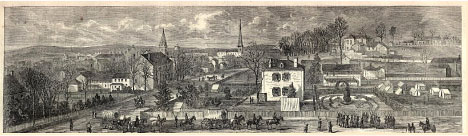
We have a precious few visual images of Huntsville during the Civil War. Several photographs exist. Harper’s Weekly and Frank Leslie’s Illustrated Newspaper published a few woodcuts. The best and most accurate woodcut made in Huntsville was published by Harper’s Weekly March 19, 1864, and captioned “HUNTSVILLE, ALABAMA, FROM GENERAL LOGAN’S HEAD-QUARTERS.” It was discovered by Henry B. Chase (1870-1961), founder of Chase Nursery, who tediously rummaged through records in Washington, D.C. He had a vested interest – his home, “McDowell 1848 (517 Adams Street) purchased in 1925, was in the woodcut.
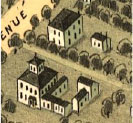
The woodcut was made from the belvedere that once existed atop “Moore Rhett 1860” (603 Adams), constructed for Robert H. Watkins. The 1871 Ehrgot & Krebs Lithograph, colloquially called the “bird’s eye view” map, showed both homes.
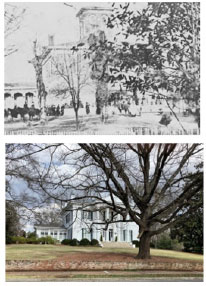
During the second Union Army occupation of Huntsville in the winter of 1863-1864, General John A. Logan, commander of XV Corps, took 601 Adams as his residence and 517 Adams as his headquarters. This grainy photographic image, made at the time from Cruse Alley, shows the two-story belvedere. (courtesy U.S. Military Institute Carlisle Barracks) The 2025 photograph was made from the same vantage point. The neoclassical portico was added circa 1921, and the belvedere was removed circa 1947.
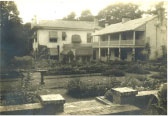
The artist made the woodcut from the belvedere, a two story tower, accessed by a spiral staircase. The Italianate belvedere gave a sweeping view of the city and surrounding landscape. In the foreground are Union soldiers and wagons moving east on Bradley Street (no longer existing) to campgrounds behind the homes. The house in the center is 517 Adams, topped by a large Stars and Stripes, was General Logan’s headquarters. In this circa 1926 photograph the service building in the rear looks like it did in 1864. (courtesy Martha Falt Priddy) On the far left of the woodcut is a corner of “Yeatman 1825” (528 Adams). At left center is “Clarke Dorning 1835” (518 Adams). To its left in the distance is the rear of “Bibb 1836” (300 Williams) with outbuildings and above that, the parapeted roof is the 1860 Huntsville Hotel at the corner of Jefferson and Spring Streets. The domed building to its right is the 1842 Courthouse. The spires are the Church of the Nativity and the First Presbyterian Church. The latter was toppled by a storm in 1878. To the right of the Nativity spire is St. Mary of the Visitation Catholic Church. On the hill at the right is the rear of “McClung 1838” (416 McClung). To its right is the Gooch home on McClung razed by the Union Army for Fort Taylor in April 1864.
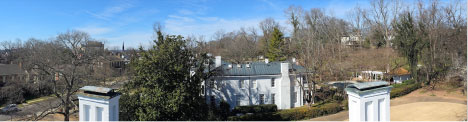
Compare the woodcut to the modern view from 603 Adams. Thanks to the graciousness of Leslie Rhett Crosby and husband Moss, Deane Dayton (Huntsville History Collection) and I were granted access to the roof in an attempt to replicate the woodcut. Deane’s panoramic photograph was made on February 12, 2026, 161 years after the woodcut. The belvedere gave the artist a 20 foot or so height advantage. Several homes and structures on the woodcut are discernible in the photograph. 517 Adams is in the center foreground. The original home is partially hidden by a tree and the 1989 wing on its south side. One of its chimneys is visible. At the left is a portion of 528 Adams. Above the left chimney of 603 Adams is 518 Adams over which the courthouse and Church of the Nativity are visible. At right is the rear of 416 McClung. Woodcuts were often not as accurate unless made from photographic images. The woodcut is so accurate that it is possible it was made from a photograph taken at the time of the 1864 photograph.
– Patrick H. Graves, Jr.